The Complete Guide to Selecting a Yakitori Sauce OEM | Key Comparison Points for Scale Production and Export Readiness
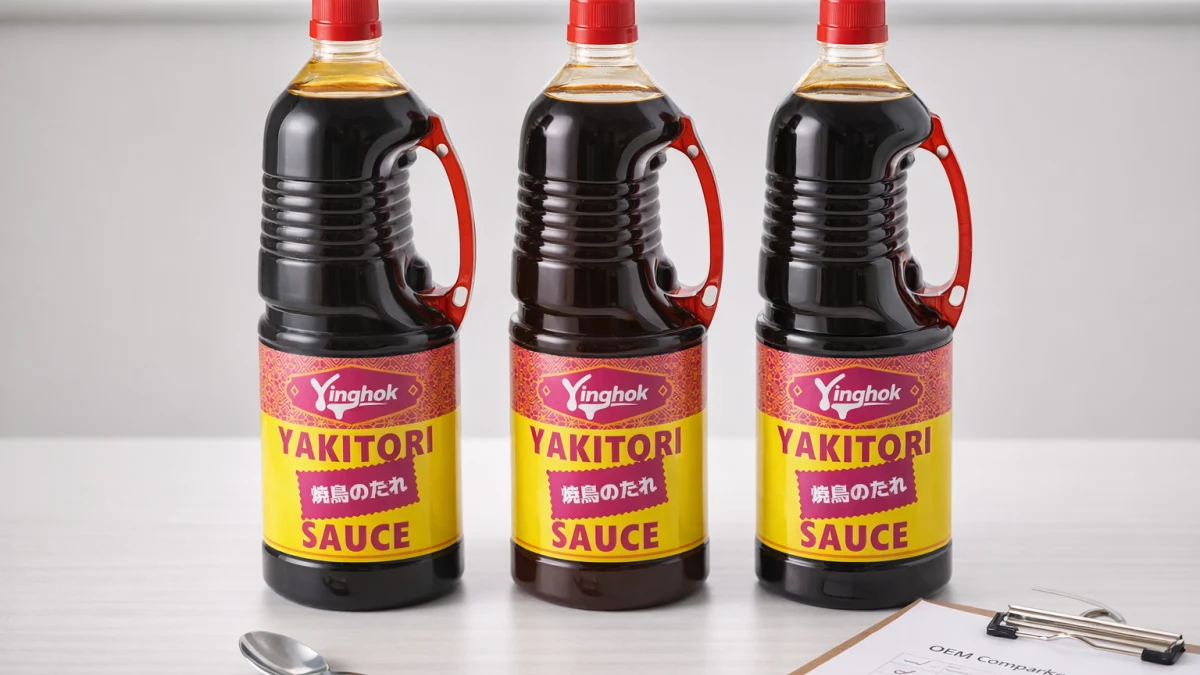
The Complete Guide to Selecting a Yakitori Sauce OEM | Key Comparison Points for Scale Production and Export Readiness
Selecting a yakitori sauce OEM partner grows more challenging every year for product development managers at foodservice chains, prepared-food manufacturers, and frozen-food manufacturers. In addition to domestic foodservice demand, the expansion of Japanese cuisine menus overseas has created a need for partners who can deliver both scale production and export readiness. This article organizes a comparison framework that goes beyond flavor evaluation alone to include mass production, supply stability, and certification readiness. Use it as a practical checklist for OEM selection.
Characteristics of the Yakitori Sauce OEM Market and the Background to Rising Demand
Yakitori sauce is a liquid seasoning with a broad range of applications—foodservice chains, prepared foods, frozen foods, and overseas Japanese restaurants. In recent years, the growth of the ready-to-eat market has driven increasing large-lot demand for prepared and frozen foods.
Furthermore, against the backdrop of the popularity of Japanese cuisine overseas, inquiries for yakitori sauce are rising from local Japanese restaurant chains and export-oriented processed products. For these overseas projects, compliance with each country's food regulations is a prerequisite, in addition to flavor reproducibility.
As a result, OEM partners are now expected to possess the comprehensive capability to handle both "domestic foodservice scale production" and "export certification and labeling compliance." It is worth noting that selecting a manufacturer that can merely reproduce a flavor tends to expose challenges during the mass-production and export phases.
Items to Verify During Small-Batch Trials
The first step in an OEM project is the small-batch trial. Neglecting verification at this stage leads to significant rework after the transition to mass production. Be sure to address the verification points specific to yakitori sauce.
Balancing Viscosity, Sugar Content, and Char Character
For yakitori sauce, viscosity design—which determines how well the sauce coats the meat—is critical. Low viscosity causes dripping, while excessive viscosity reduces the workability of application on-site. Sugar content is directly linked to glaze and char character, and it is the element that determines the aroma during cooking.
The optimal char character differs depending on the cooking method, such as charcoal grilling, grilling, or oven cooking. It is essential to conduct heat tests at the trial stage that simulate actual cooking operations.
Yield and Compatibility with the Meat
In trials, verify not only flavor but also yield. The sauce adhesion rate and the residual amount after heating are practical metrics directly tied to cost calculation. Verifying compatibility with the target cuts and processed products—such as chicken thigh, breast, and tsukune—will make adjustments smoother during mass production.
Common Challenges During the Transition to Mass Production and Countermeasures
Even when the ideal flavor is achieved in a small-batch trial, it is not uncommon for quality to change during the transition to mass production. Understanding these challenges in advance allows you to gauge a partner's capabilities.
The first is flavor drift. When raw-material lots or production scale change, flavor variation is more likely to occur. To suppress this, stable raw-material procurement and standardized production management are essential.
The second is heat resistance and lot-to-lot variation. In large-lot production, the conditions of the heating and cooling processes differ from those during trials, which can affect viscosity and flavor. The third is changes to filling specifications. When packaging changes from the small trial containers to 1.8L PET bottles, gallon cans, or large foodservice bags, filling suitability must be re-verified.
To address these challenges, manufacturers with automated mass-production lines and sufficient production capacity have an advantage. Small-scale production centered on manual work tends to have limitations in suppressing lot-to-lot variation and ensuring stable supply.
Certification and Labeling Compliance Required for Export
When supplying yakitori sauce overseas, each country's food regulations and certification readiness become a critical point of differentiation in selection. Even with great flavor, a project will stall during the export phase without the accompanying certifications.
Supply to the U.S. requires compliance with the FDA (U.S. Food and Drug Administration), while inbound tourism and Islamic markets require HALAL compliance. HALAL is a certification issued by bodies such as BPJPH (Indonesia) and JAKIM (Malaysia), and the number of manufacturers able to comply is limited.
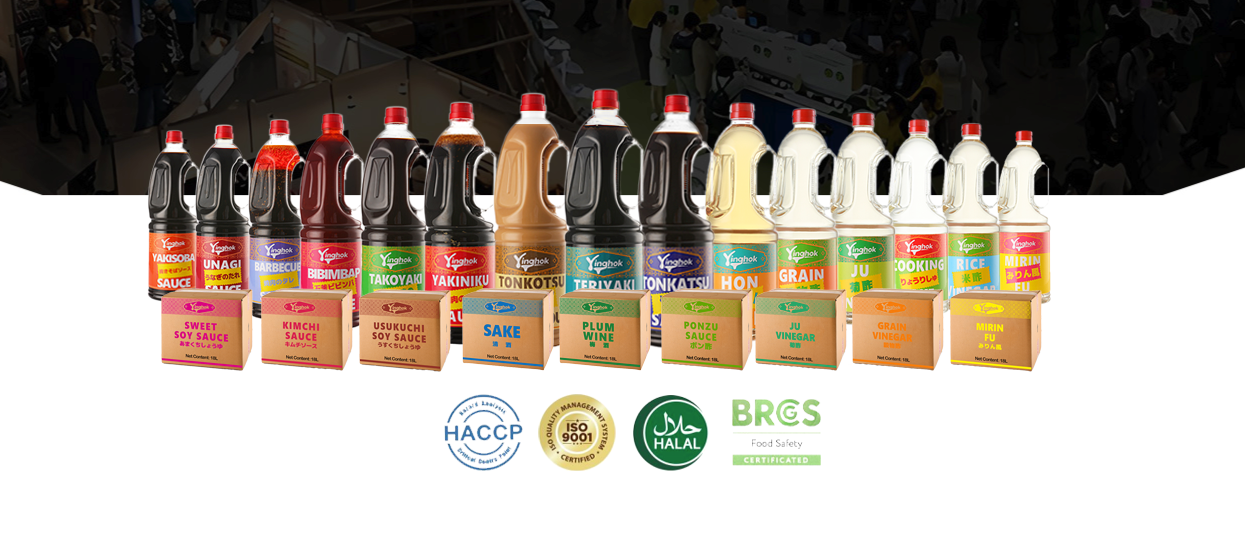
In addition, international food safety management certifications are an important item to verify. When comparing partners, checking the status of certifications such as HACCP, ISO 9001, ISO 22000, BRCGS, FDA, and HALAL all at once allows you to objectively judge export suitability.
Key Points for Comparing OEM Partners
Based on the above, here is an organized set of perspectives for comparing yakitori sauce OEM partners.
| Comparison Perspective | Verification Points |
|---|---|
| Small-batch trials | Is there flexibility for small-volume trials and multiple trial rounds? |
| Development capability | Can they handle not only flavor adjustment but also application proposals? |
| Production capacity | Do they disclose annual production capacity and automated lines? |
| Supply stability | Do they have a track record of multiple sites and continuous supply? |
| Certification readiness | Do they have a track record of export certifications such as HALAL and FDA? |
| Improvement support | Can they handle specification changes and improvements after the OEM is established? |
From the standpoint of supply stability, the number of production sites and the disclosure status of supply track records serve as decision-making criteria. For example, Nakano Foods discloses a track record of supplying more than 10,000 companies across 50+ countries, presenting information that is easy to compare for trading companies and wholesalers considering supplier diversification and risk dispersion.
An Example of a System That Combines Scale-Production Stability and Export Readiness
In liquid seasoning OEM, including yakitori sauce, the ability to outsource everything from development to packaging as a single package significantly affects product development efficiency. A manufacturer that handles OEM/ODM/Private Label can advance formula development, flavor adjustment, application proposals, and packaging design seamlessly from end to end.
In the case of Nakano Foods, the company has accumulated mass-production expertise across a wide range of liquid seasonings, including ramen soups (more than 30 flavor variations), hot pot soups, various sauces, and fermented seasonings. Even for products that require the design of glaze, viscosity, and char character—such as yakitori sauce—this accumulated expertise forms the foundation for stable mass production.
On the packaging side, the company accommodates everything from 1.8L PET bottles and gallon cans to large foodservice bags (20kg, 50kg, etc.), enabling a consistent flow from small-batch trials to mass production. In addition to overseas sites, support systems for the Japanese market are being further developed, enabling multilingual business communication.
Summary
The key to successful yakitori sauce OEM selection is to compare scale-production stability, supply continuity, and export readiness holistically, in addition to flavor reproducibility. In small-batch trials, verify viscosity, sugar content, char character, and yield; during the transition to mass production, verify flavor drift, heat resistance, and filling specifications. If you anticipate overseas expansion, a proven track record in certification compliance—including HALAL and FDA—is indispensable.
Use the comparison points in this article as a checklist to identify a partner that matches your applications and expansion plans. We recommend advancing trial consultations and verification of certification and export readiness concretely at an early stage.
Request a free sample
Try our products with a free sample. Feel free to get in touch.
Request a sampleRelated Articles
 Guide
GuideCompound Seasoning OEM/Private Label: Bringing Your Own-Brand Seasonings to the World
A guide to developing compound seasonings via OEM/private label. Covers integrated production of sauces, tare, and soup bases, HALAL compliance, Japan-quality export capabilities, and key points from small-batch prototyping to mass production—written for B2B procurement professionals.
 Guide
GuideNew Plant Boosts Reach from 50 to 100 Countries | Asian Seasoning OEM
A guide to Asian seasoning OEM/PB supply capabilities. Learn how Nakano Foods aims to expand from 50+ to 100 countries through its new plant—covering production capacity, certifications, and multinational flavor expertise for trading companies and product developers.
 Guide
GuideStandardizing Flavor and Soup Base OEM: The Key to Private Labeling Mala Tang
The biggest hurdle in creating your own mala tang (spicy hot soup) product is flavor standardization. The key to reproducing a popular restaurant's taste at scale lies in the soup base. This article explains the essentials of OEM, private label, and retort-pouch production.