Sauce & Marinade OEM/Private Label Development: Process and Cost Fundamentals
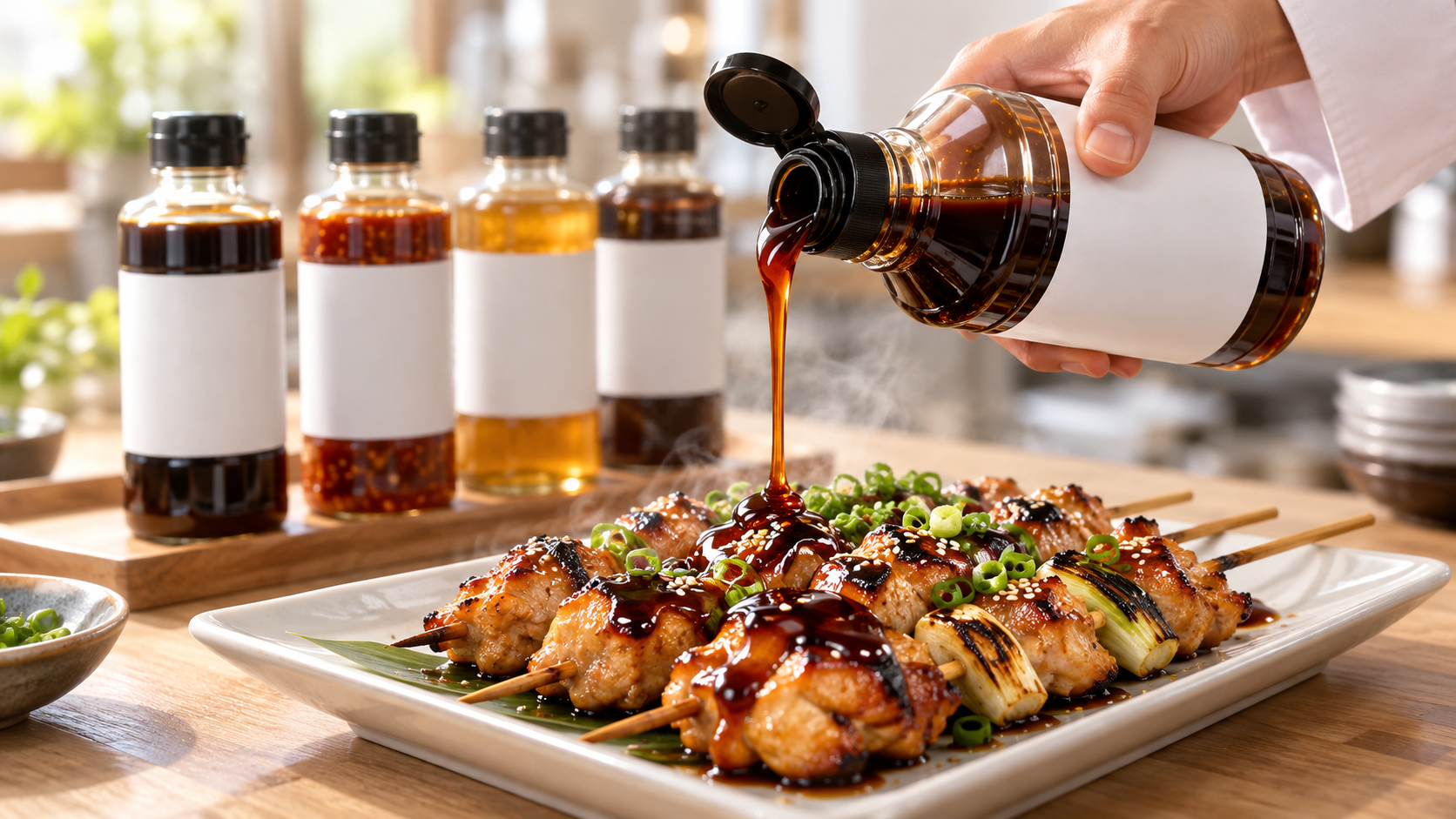
Sauce & Marinade OEM/Private Label Development: Process and Cost Fundamentals
"I want to turn our signature flavor into a finished product." Many restaurant chains, food trading companies, and product development managers share this goal. In reality, however, projects often stall because teams don't know how to find a factory, what costs to expect, or what the minimum order quantity is. This article concisely outlines the full picture of OEM/private label development for sauces and marinades, how to think about cost, and the key points for choosing the right manufacturer.
Why Sauce & Marinade OEM Projects Tend to Stall
Most obstacles in creating a private label condiment come down to one thing: a lack of information. Which factory should I approach? What's the minimum quantity I can produce? How much will it cost? Because these three points remain unclear, teams struggle to take the first step.
What's more, because sauces and marinades are liquid seasonings, there are many considerations—flavor reproducibility, shelf stability, and compatibility with packaging. For imported products, compliance with Japanese food standards is also required. Whether you have a partner who can address all of these in one place is the key to keeping your project moving.
The 6 Steps of OEM/Private Label Development
OEM/private label development for sauces and marinades generally follows the process below. Knowing what to confirm at each stage makes communication dramatically smoother.
1. Consultation
Align on the flavor direction, intended use (pouring, tossing, dipping, etc.), specifications, and projected volume. The more specific the information at this stage, the greater the accuracy of every subsequent step.
2. Prototyping & Flavor Reproduction
Using samples or recipes of your existing product, the factory produces prototypes. How faithfully your signature flavor can be reproduced is where a manufacturer's technical capability is truly tested.
3. Tasting & Refinement
Taste the prototypes and adjust salinity, sweetness, viscosity, and more. Expect multiple rounds, and defining your evaluation criteria internally beforehand will speed up decision-making.
4. Packaging & Label Selection
Finalize the volume, container shape, and label design. The optimal packaging differs depending on whether the product is for foodservice or retail sale.
5. Standards Verification & Import Documentation
Imported products must be formulated to meet Japanese food additive standards. In addition, prepare the documentation required for filing with quarantine authorities, including product specifications, raw material specifications, and manufacturing process diagrams.
6. Mass Production & Shipment
Once specifications are finalized, production begins and the product ships.
The 5 Factors That Drive OEM Cost
OEM/private label costs are not fixed; they vary by specification. Organizing the following five factors before requesting a quote will keep the conversation moving quickly.
- Formulation & raw materials: the grade and type of ingredients used
- Packaging & volume: varies by format, from small pouches to large foodservice sizes
- Labeling & printing: design, printing method, and whether plates are required
- Lot size: the larger the volume, the lower the per-unit cost tends to be
- Logistics & import conditions: transport format and import-related procedures
Key Points for Choosing the Right Manufacturer
When dealing with imported condiments, the biggest pitfall is "standards and documentation." A formulation that fails to meet Japanese food additive standards simply cannot be distributed. Preparing the documentation for filing with quarantine authorities also requires specialized expertise.
For this reason, selecting a manufacturer experienced in import operations and formulation design for the Japanese market is the single best way to avoid failure. Beyond the ability to reproduce flavor, confirm whether they can also support the creation of specification documents.
Summary: Start by Clarifying Use and Volume
OEM/private label development for sauces and marinades is by no means difficult once you understand the 6-step process and the 5 cost factors. What matters is clarifying your "intended use" and "volume" before you consult—and choosing a manufacturer well-versed in Japanese food standards and import documentation.
Nakano Foods, the company behind YINGHOK, manufactures Japanese-style and Asian liquid seasonings at its own facilities. We support flavor reproduction from samples and the adjustment of salinity and taste. Volumes range widely, from 10 ml pouches to 18 L and 20 L foodservice sizes, with private label products available from 3,000 units. Free samples are also available.
Start by telling us the flavor you envision and your target volume. Why not begin creating your own branded condiment with a free sample request or consultation?
Request a free sample
Try our products with a free sample. Feel free to get in touch.
Request a sampleRelated Articles
 Guide
GuideHow to Eliminate Flavor Inconsistency in Malatang | The Key to Standardizing Store Operations
The key to eliminating flavor inconsistency in malatang is standardization through a pre-formulated soup base. This article explains the flavor reproducibility and operational design essential for multi-location expansion and customer retention.
 Guide
GuideThe Complete Guide to Halal-Compliant Japanese Sauces & Seasoning OEM
For food manufacturers, trading companies, and exporters considering halal Japanese sauce OEM, this guide explains how to design and select products that bring authentic Japanese flavors—such as yakiniku sauce and teriyaki—to Muslim markets.
 Guide
GuideHow to Turn Malatang into a Retort Pouch Product | The OEM Process
A guide for food manufacturers and trading companies exploring retort pouch products for malatang. From flavor standardization and mass-production consistency to regulatory compliance and shelf-life design, we outline the OEM process and the soup base that is key to success, all from a practical standpoint.